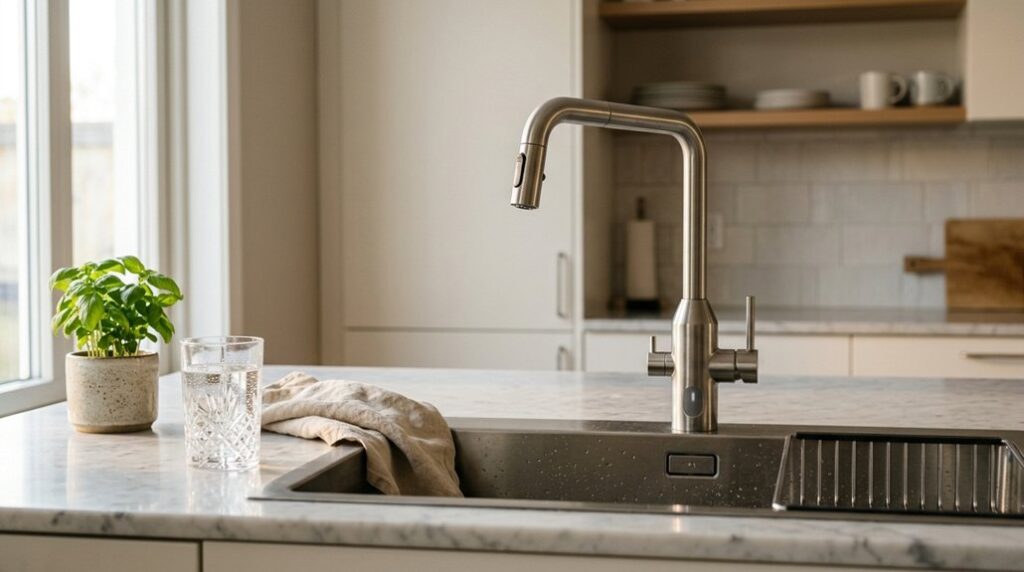
If you’re concerned about what’s flowing from your kitchen tap, you’re not alone. Water quality matters, and I’ve researched the top water filter kitchen sinks for 2026 to help you understand your options.
Whether you’re dealing with chlorine taste, lead concerns, or invisible contaminants like PFAS and microplastics, there’s a solution that fits your space and budget. But here’s where it gets interesting: not all filters work the same way.
Waterdrop 10UA Under Sink Water Filter System
If you’re renting, need a compact solution that won’t upset your landlord, or just want something you can install in three minutes flat, the Waterdrop 10UA might be your answer. This under-sink system reduces PFAS, PFOA/PFOS, lead, and chlorine while preserving essential minerals like calcium and magnesium.
The twist-and-lock design connects to standard 3/8 cold water lines, and you’ll swap filters in just three seconds when the time comes. With an 11,000-gallon capacity lasting up to 12 months on municipal water, you’re looking at affordability without constant replacement hassles. NSF/ANSI 42 certified and backed by a one-year warranty, it delivers solid performance for kitchens, bathrooms, and RVs alike.
Best For: Renters and apartment dwellers who need a compact, easy-to-install water filtration system that won’t damage plumbing or violate lease agreements.
Pros:
- Lightning-fast installation (3 minutes) and filter replacement (3 seconds) with twist-and-lock design
- Removes harmful contaminants like PFAS, PFOA/PFOS, and lead while retaining beneficial minerals
- Long-lasting 11,000-gallon capacity lasts up to 12 months on municipal water
Cons:
- Cold water only—incompatible with hot water lines or well water systems
- Maximum 12-month service life requires regular filter replacements to maintain effectiveness
- Not suitable for smart-home integration or advanced filtration upgrades beyond UF or MZ filter compatibility
PUR Plus Vertical Faucet-Mount Water Filtration System
The PUR Plus Vertical Faucet-Mount Water Filtration System is your answer if you want filtered water without the counter clutter. This compact faucet-mount design uses 3-in-1 filtration technology to reduce lead and NSF-certified substances including microplastics and chlorine. You’ll appreciate the on/off lever that lets you switch between filtered and unfiltered water, plus the convenient filter change light that alerts you when replacement’s due.
With a 100-gallon capacity lasting about three months, installation requires no tools, and it fits most standard faucets, making this a practical choice for home or RV use.
Best For: This system is best for environmentally-conscious homeowners and RV users who want convenient, affordable filtered water without taking up counter space.
Pros:
- No tools required for installation and easy on/off lever makes switching between filtered and unfiltered water effortless
- NSF-certified 3-in-1 filtration reduces lead, microplastics, chlorine, and 70 other chemical and physical substances—10x more effective than leading pitcher filters
- Significant reduction in plastic waste over time
Cons:
- Not compatible with pull-out or handheld faucet models, limiting installation options in some kitchens
- Filter requires replacement every 3 months or 100 gallons, which means ongoing replacement costs
- Not smart-home compatible and manual operation means no automated alerts beyond the basic filter change light
ICEPURE Under Sink Water Filter System (22000 Gallons)
You’ll want this system if you’re serious about water quality without the installation headache. I appreciate how this under-sink filter gives you 22,000 gallons of capacity, meaning you won’t replace it for three years. Setup takes less than three minutes with no professional help needed.
The 0.5 micron outer layer and coconut shell carbon tackle heavy metals and chlorine while boosting taste and odor. With NSF certifications backing its lead-free construction, you get reliable filtration for drinking, cooking, and even your humidifier. At 2.5 GPM flow rate, you won’t sacrifice water pressure either.
Best For: Homeowners and renters seeking hassle-free water filtration with minimal installation effort and maximum capacity for drinking, cooking, and household uses without professional help.
Pros:
- Exceptional 22,000-gallon capacity with 3-year lifespan means infrequent filter replacements and long-term cost savings
- Ultra-simple installation in under 3 minutes with no tools or professionals required, plus quick 2-second filter changes
- NSF-certified with coconut shell carbon and 0.5 micron filtration effectively removes heavy metals, chlorine, and improves taste while maintaining strong 2.5 GPM flow rate
Cons:
- Requires 1/2 or 3/8 female NPT thread connection, which may not be compatible with all existing plumbing setups without adapters
- Limited to cold water lines only, restricting its use for hot water applications like tea or washing
- 1-year warranty period is relatively short compared to the 3-year filter lifespan, offering limited coverage if issues arise
Brita Faucet Mount Water Filter System (White)
Brita’s faucet-mount filter works best for renters and apartment dwellers who need filtration without renovation. I appreciate its straightforward design: you install it in minutes without tools, and it fits standard faucets seamlessly.
The system reduces over 60 contaminants, including lead up to 99%, chlorine taste and odor, asbestos, and benzene. You’ll get three spray options built in, which gives you flexibility for different tasks. The status indicator tells you when replacement’s due every 100 gallons or roughly 4 months. One-click filter swaps mean maintenance stays simple.
Its compact footprint (5.28″ tall) won’t crowd your sink area, making it ideal for small kitchens and bathrooms.
Best For: Renters, apartment dwellers, and anyone seeking quick, tool-free water filtration without permanent installation or renovation.
Pros:
- Tool-free installation in minutes with compatibility for standard faucets and compact design that won’t crowd sink space
- Reduces 60+ contaminants including lead (up to 99%), chlorine taste/odor, asbestos, and benzene with three spray options for versatility
- Simple maintenance with status indicator alerts and one-click filter replacement every 100 gallons or approximately 4 months
Cons:
- Only compatible with standard faucets; incompatible with pull-out or spray-style faucets
- Filtration performance depends on contaminants present in your specific water supply; not all reduced substances may be in every user’s water
Waterdrop TSA 8 Layer Under Sink Water Filter System
Want clean water that actually tastes good without replacing your kitchen setup? The Waterdrop TSA 8 Layer Under Sink Water Filter System connects directly to your cold water line and tackles what matters: PFAS, PFOA/PFOS, fluoride, and chlorine that affects taste.
You get three filters with different lifespans (6 months to 18 months), handling up to 8,000 gallons total. Installation takes under three minutes with push-to-connect fittings, and filter swaps take about three seconds. The system preserves beneficial minerals while delivering steady flow around 1.5 GPM. It’s NSF/ANSI certified, freeze-resistant, and built tough enough to handle pressure testing that’d make most systems nervous.
Best For: Homeowners with municipal water supplies seeking an easy-to-install under-sink system that reduces PFAS, fluoride, and chlorine while maintaining essential minerals and delivering reliable filtration performance.
Pros:
- Ultra-fast installation (under 3 minutes) and filter replacement (3 seconds) with push-to-connect fittings requires no special tools or plumbing expertise
- Comprehensive 8-stage filtration removes PFAS, PFOA/PFOS, fluoride, chlorine, and sediment while preserving beneficial minerals like calcium and magnesium
- Durable construction with extensive pressure testing (400 psi burst, 100,000+ pulse tests) and freeze-resistant design ensures long-term reliability and leak prevention
Cons:
- Limited to cold water only and requires pre-filtration system for well water, restricting its versatility for certain households
- Filters require regular replacement at staggered intervals (6 to 18 months), creating ongoing maintenance needs and supply chain dependency
- Slower flow rate after full filtration due to purification design trade-off, and system does not reduce TDS or provide mineral adjustment for specific water quality preferences
Waterdrop G3P600 Reverse Osmosis Water Filter System
The Waterdrop G3P600 consistently ranks as the best choice for anyone craving restaurant-quality water without sacrificing under-sink cabinet space. This tankless reverse osmosis system delivers 600 gallons daily through an 8-stage filtration process that eliminates TDS, chromium, PFAS, arsenic, and fluoride while maintaining an impressive 2:1 pure-to-drain ratio.
I appreciate how the smart display faucet tracks filter life and monitors TDS levels in real time. Installation takes minutes without tools, and you’ll fill an 8-ounce cup in just 8 seconds. NSF/ANSI certifications ensure you’re getting legitimately filtered water, not marketing promises.
Best For: Homeowners seeking high-capacity filtered water who have limited under-sink cabinet space and want fast, convenient access to restaurant-quality water with minimal maintenance.
Pros:
- Tankless design saves 70% under-sink space while delivering 600 GPD with impressive 2:1 pure-to-drain ratio
- Smart display faucet provides real-time TDS monitoring and automatic filter life tracking with tool-free 3-second filter changes
- Comprehensive 8-stage filtration with NSF/ANSI certifications removes 15+ contaminants including PFAS, chromium, arsenic, and fluoride
Cons:
- Requires corded electric power connection under sink, limiting installation flexibility in some cabinet configurations
- Requires cabinet space larger than the product’s 18.12″ x 5.67″ x 17.72″ dimensions for proper installation and maintenance access
Waterdrop FC-01 Sink Faucet Water Filter NSF Certified
Looking for straightforward chlorine and taste reduction without complicated installation? The Waterdrop FC-01 delivers exactly that. This NSF-certified faucet filter attaches directly to your standard sink tap with included adapters, requiring zero plumbing knowledge.
You’ll get approximately 320 gallons of filtered water per cartridge, which typically lasts three months with everyday use. The filter reduces chlorine, taste, and odor while its advanced ACF material tackles lead reduction. What I appreciate most is the simple toggle between filtered and regular water, letting you preserve filter life for when you actually need it.
Just verify your faucet compatibility first, since it won’t work with pull-out, handheld, spray, or sensor models.
Best For: Homeowners with standard faucets who want an easy, no-plumbing-required solution for reducing chlorine, taste, and odor without dealing with complicated installation or maintenance.
Pros:
- Simple installation with included adapters and no plumbing knowledge required
- NSF-certified filtration that reduces chlorine, taste, odor, and lead with approximately 320 gallons per filter lasting about 3 months
- Toggle switch between filtered and regular water allows you to extend filter life by using filtered water only when needed
Cons:
- Not compatible with pull-out, handheld, spray, or sensor faucets, limiting installation options for many users
- Does not reduce total dissolved solids (TDS), so it won’t soften hard water or address mineral content
Waterdrop UA-5Y Under Sink Water Filter System
If you’re tired of chlorine taste and concerned about contaminants like PFOA and PFOS, this five-year under sink filter might be exactly what you need. The UA-5Y uses a 0.5 micrometer activated carbon block that tackles chlorine, odors, turbidity, rust, and sand while preserving essential minerals like calcium and magnesium.
Installation takes minutes with no special tools required, and it won’t strain your water pressure or demand electricity. With its 1.33 GPM flow rate and five-year lifespan, you’re looking at reliable performance for typical household use. The system arrives with all necessary components, making setup straightforward for any homeowner seeking cleaner tap water without complexity.
Best For: Homeowners seeking an affordable, long-term under-sink water filtration solution that removes chlorine, taste, odor, and contaminants like PFOA/PFOS while maintaining essential minerals.
Pros:
- Five-year filter lifespan with prorated warranty provides extended value and reduced maintenance frequency for typical household use
- Quick DIY installation with no electricity required, no special tools, and minimal water pressure impact makes setup accessible for any homeowner
- 0.5 micrometer activated carbon block effectively removes chlorine, odors, turbidity, rust, sand, and harmful contaminants while preserving beneficial minerals like calcium and magnesium
Cons:
- Not suitable for well water, limiting applicability for rural or non-municipal water sources
- Physical size (3.9″L x 3.6″W x 16.7″H) requires adequate under-sink cabinet space, which may be problematic in compact kitchen layouts
- Maximum flow rate of 1.33 GPM may noticeably reduce water pressure in households with high water demand or multiple simultaneous users
Delta Clarifi High Flow Under Sink Water Filter
Delta’s Clarifi system works beautifully if you want serious filtration without fussing with your faucet setup. I appreciate how this under-sink filter reduces microplastics and chlorine taste and odor using activated carbon, and it’s certified to NSF standards 42, 372, and 401.
The high-flow design handles up to 10,000 gallons yearly, so you’re not sacrificing water pressure for clean water. What really sold me is the tool-free filter changes taking under a minute, plus the LCD display that tracks both filter life and battery status. Installation connects directly to your existing kitchen or bathroom faucet without needing a separate beverage spout, making it genuinely convenient for everyday use.
Best For: Households seeking comprehensive water filtration without installation complexity, prioritizing reduced microplastics and chlorine removal with minimal maintenance effort.
Pros:
- High-flow capacity (10,000 gallons/year) maintains strong water pressure while delivering NSF-certified filtration across standards 42, 372, and 401
- Tool-free filter replacement in under one minute with LCD status monitoring eliminates maintenance hassle and guesswork
- Direct connection to existing faucet in kitchen or bathroom requires no additional beverage spout, providing versatile installation flexibility
Cons:
- Filter replacement required annually or at 10,000 gallons, creating recurring maintenance costs and environmental waste from cartridge disposal
- LCD display requires battery monitoring with no specified external power option, potentially limiting long-term reliability and convenience
- Maximum water TDS support of 300 PPM limits effectiveness in areas with higher mineral content or severely contaminated water supplies
Frizzlife Under Sink Water Filter System NSF Certified
The Frizzlife SP99 is built for homeowners who want lab-certified filtration without the plumber’s bill. You’ll get NSF/ANSI 42 and 53 certification, meaning the system handles lead, chlorine, PFAS, and chloramine effectively while keeping beneficial minerals intact.
The 8-layer filtration achieves 0.5 micron accuracy, delivering a cup of pure water in roughly three seconds. Installation takes about 15 minutes, requires no professional help, and the compact design fits snugly under most sinks. You’re only replacing core filters, not the entire housing, which reduces waste over time. The included lead-free faucet comes in brushed nickel, and the system works with optional ice maker kits for expanded household usage.
Best For: Homeowners seeking NSF-certified water filtration with easy DIY installation who want to remove contaminants like lead and PFAS while maintaining beneficial minerals without professional plumbing costs.
Pros:
- NSF/ANSI 42 and 53 certified with 8-layer filtration at 0.5 micron accuracy, effectively removing lead, chlorine, PFAS, chloramine, and other contaminants while preserving beneficial minerals
- Quick and easy DIY installation in approximately 15 minutes with no plumber required, plus compact under-sink design that saves cabinet space
- Long-term maintenance since you only replace core filters rather than the entire housing, reducing waste
Cons:
- Limited to under-sink installation, so it doesn’t provide filtered water at multiple points throughout the home like whole-house systems do
- Requires periodic filter cartridge replacements (M3001, M3002, M3003 models) to maintain filtration performance
- Optional ice maker kit (IMC-1) requires additional purchase for simultaneous usage with refrigerators, and system performance may vary depending on household water pressure conditions
Factors to Consider When Choosing a Water Filter Kitchen Sink
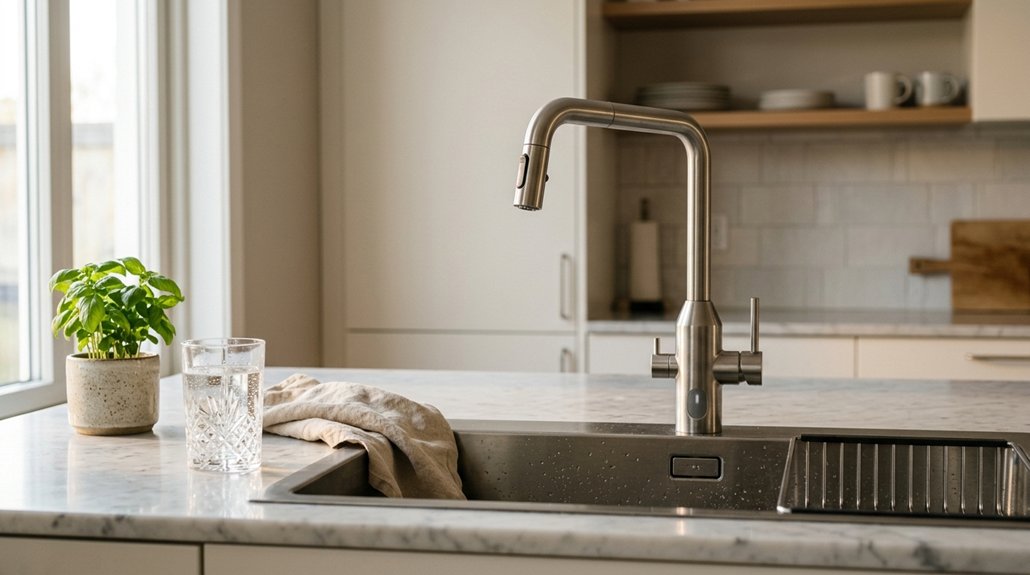
Before you invest in a water filter kitchen sink, I’d recommend evaluating several key factors that’ll directly impact your satisfaction and long-term costs, including the filtration technology’s effectiveness, how easily it’ll fit under your existing sink, and what you’ll realistically spend on replacement filters over time. You’ll also want to check the flow rate to ensure you’re not stuck waiting forever for a glass of water, plus verify that whatever system you choose meets important certification standards like NSF or WQA that guarantee its safety and performance. And here’s the thing: understanding these elements upfront means you’ll choose a system that actually aligns with your home’s setup and your budget, rather than discovering problems after installation.
Filtration Technology And Performance
When you’re evaluating water filter kitchen sinks, what actually happens inside that filter matters more than the sleek exterior promises. I’ll walk you through the core technologies that actually remove contaminants from your water.
Most systems use one of three primary approaches: activated carbon blocks, multi-stage carbon filters (often 8-stage designs), or reverse osmosis membranes. Each targets different nasties like chlorine, PFAS, lead, and heavy metals. The particle size matters too: a 0.5 micron outer layer catches finer sediment while coconut-shell carbon retains beneficial minerals.
You’ll see flow rates ranging from 0.75 to 2.5 GPM, and capacity between 11,000 and 22,000 gallons before replacement. NSF/ANSI certifications validate these claims. Most filters last 3 months to 5 years depending on design and water quality.
Installation Complexity And Compatibility
How much space do you actually have under your sink? That’s the first question I’d ask before choosing a filter system. Most under-sink units use standard 3/8″ or 1/2″ cold-water lines with push-to-connect fittings, making installation surprisingly quick, often under 3 minutes.
But here’s where compatibility matters: your faucet type determines everything. Standard faucets work great, yet pull-out, handheld, spray, and sensor models aren’t compatible with many systems. You’ll also need to verify inlet thread sizes (1/2″ or 3/8″ female NPT) and check whether you need adapters.
Tankless designs save cabinet space, though some require larger footprints. Consider filter replacement intervals and flow rates too, as multi-stage systems need room for additional hoses and fittings. Measure twice, install once.
Filter Lifespan And Replacement Costs
Your filter’s actual lifespan matters far more than the price tag on the initial system, and I’ve found that many people overlook this critical cost factor when making their choice. Replacement frequency varies wildly depending on your filter type.
Budget models like PUR Plus need replacing every three months at roughly 100 gallons, while multi-stage under-sink systems stretch 12 to 18 months. That said, real-world performance depends heavily on your water’s TDS and contaminant load. Higher contamination means shorter intervals and more frequent cartridge purchases.
I’d recommend calculating annual replacement costs before buying, since premium filters with pricey cartridges sometimes cost less overall than cheaper systems requiring constant swaps. Warranty coverage and prorated replacement programs sweeten the deal considerably too.
Flow Rate And Water Pressure
Ever notice how your filtered water slows to a trickle while your regular tap flows freely? That’s the flow rate trade-off, and I want you to understand what’s happening. Most under-sink systems deliver 0.42 to 2.5 GPM depending on the model.
Here’s the thing: faster flow sounds great, but it can actually reduce how long water stays in contact with filtration media, potentially compromising contaminant removal. Manufacturers balance this by increasing the surface area of their filters.
Your home’s water pressure matters too. Systems work optimally between 20 and 80 psi, and if your supply pressure drops, you’ll notice reduced flow. Check your system’s specs to ensure compatibility with your home’s pressure range.
Certification Standards And Safety
When you’re deciding between water filter kitchen sinks, certifications are where the rubber meets the road. I can’t stress this enough: they’re your assurance that what you’re buying actually does what the manufacturer claims. Look for NSF/ANSI 42, which confirms taste and odor reduction, or NSF/ANSI 53 for serious contaminant removal including lead. I always recommend checking for NSF/ANSI 372 certification too, because that validates lead-free materials in your system’s components.
Some models also carry IAPMO or regional certifications like UKCA, which strengthen their credibility. When a sink displays multiple certifications stacked together, you’re getting comprehensive validation of both performance and safety. That combination gives you confidence you’re investing in genuine water quality improvement, not just marketing hype.
Space Requirements And Design
How much room do you actually have under your sink? This question matters more than you’d think when selecting a water filter system. Under-sink units range from compact 3.9″ L x 3.6″ W x 12.3″ H models to larger 6.8″ x 5.4″ x 15.6″ enclosures, so measuring your cabinet space is essential before committing.
Tankless and compact designs save precious space, but they may demand deeper mounting or additional counter clearance for hoses and adapters. Many systems include 3/8″ to 1/2″ converter sets and twist-and-lock fittings that simplify installation yet require extra clearance behind your sink.
Weight considerations matter too. Units range from 1.2 lb to over 6 lb, affecting both support needs and door clearance. And since filter heads typically connect to cold water lines only, you’ll need to verify your faucet compatibility and countertop hole requirements before installing.